Case study: Total refactor of /support
Dropbox is a well-known global SaaS product with a subpar support experience. Why?
- Consistently low customer satisfaction (CSAT) scores
- Off-brand UX that didn’t match the rest of the product
- No alignment with industry standards
- Four support surfaces (help center, support, Community, Learn) siloed across different CMSs and teams
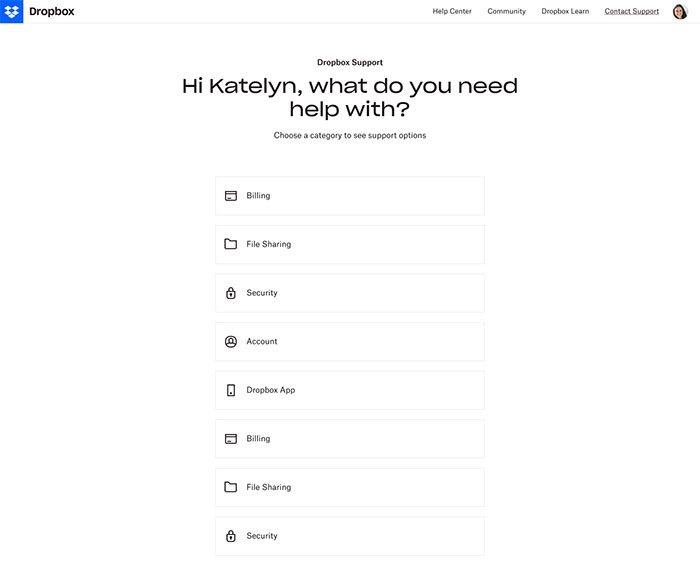
- No ownership, framework, or roadmap
- Historically low design resourcing in the CX org
01 / Why it mattered
Siloing wasn’t just a UX problem. Each of the four surfaces lived on its own CMS, which constrained our ability to make help content portable and reusable, for example, displaying help center articles inside the support flow.
Siloing was mirrored organizationally. Teams kept to themselves, building roadmaps in vacuum. The support site itself had been built ad-hoc over years, passed between teams without clear ownership. Loads of tech debt.
Dropbox Learn used a headless CMS (Contentful), which made content reusable. But migrating everything to Contentful was out of scope.
02 / Roles and team
I joined as content strategist and content designer, and became design team lead after helping hire and oversee a UX designer and UX researcher.
Our design team was a leap forward for the CX org, which had historically suffered from design atrophy. The cross-functional team included a project manager, engineers, and program managers. Allocation was limited at first, then increased as we made small wins and caught senior staff attention.
03 / Process: talking to customers
Our task: articulate customer expectations, identify the most critical UX breakpoints, navigate senior leadership, build a roadmap, ship an MVP, then iterate.
I ran sessions with customers walking through the support site. Two key insights emerged:
- How can this immediately solve my problem? Nobody visits support sites for fun. Customers want in and out, with a resolution, fast.
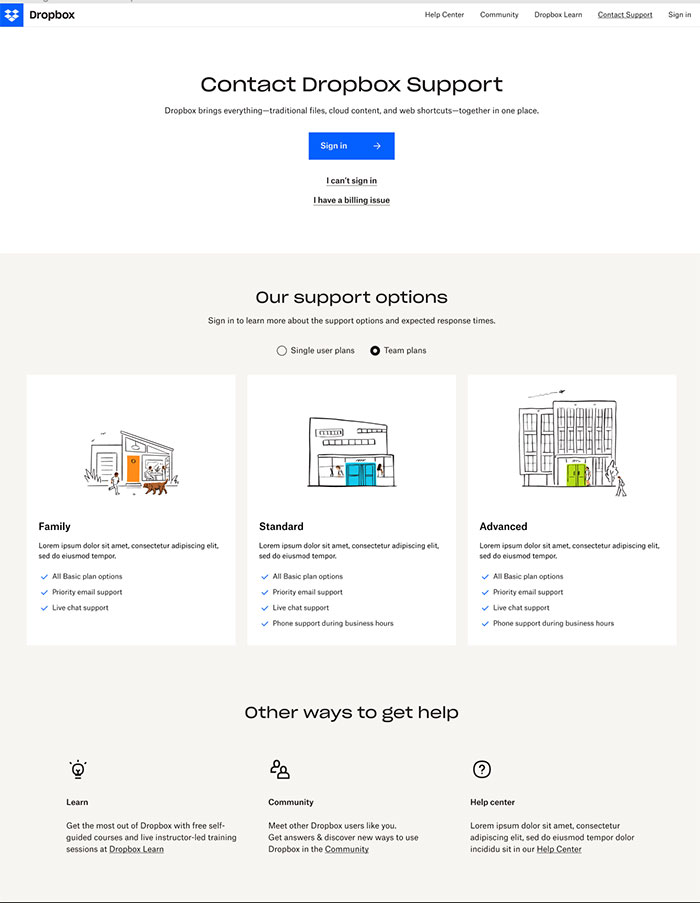
- Can I trust this support site? Customers scan for trust signals, clearly displayed support entitlements (email, phone, chat) and a way to reach a real person.
Data point: customers who trust a support site are more likely to use self-service content (help articles) before resorting to 1:1 support.
04 / Process: heuristic evaluation
We knew the UX was broken, but needed to map what was broken and why to prioritize fixes. We ran a heuristic test with designers from the core product team. The strongest feedback:
- Lack of consistency and standards, UI didn’t match the product or marketing. Inconsistent copy and elements that didn’t follow the design system.
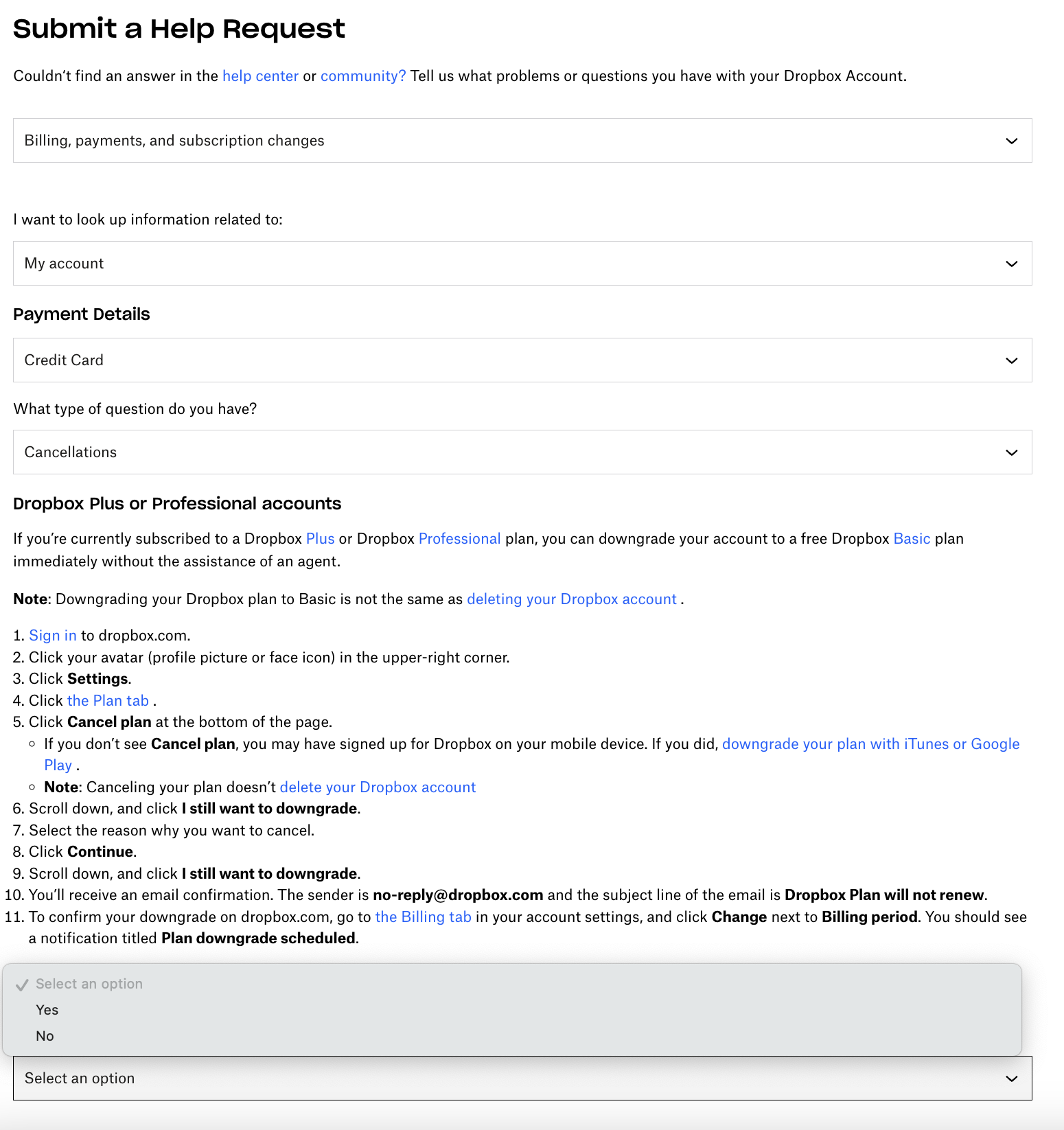
- Flexibility and efficiency, the email support form for billing routed customers through long conditional logic, embedded outdated help content, and asked for too much input.
- Visibility of system status, users entering a support flow weren’t shown their entitlements, or any expected response time after submitting a ticket.
05 / Process: best-in-class teardowns
We audited support flows from Amazon, Airbnb, Facebook, Netflix, Spotify, and others. Patterns emerged:
- Forcing user login to personalize the experience and run analytics
- Card-based design pattern to narrow down issue type
- Gating 1:1 support behind self-serve content
- Conversational, human-centered tone, referring to support as “help”: Tell us what you need help with.
- Help articles and 1:1 support integrated into a single channel rather than separate ones (as Dropbox had)
06 / Build and launch the MVP
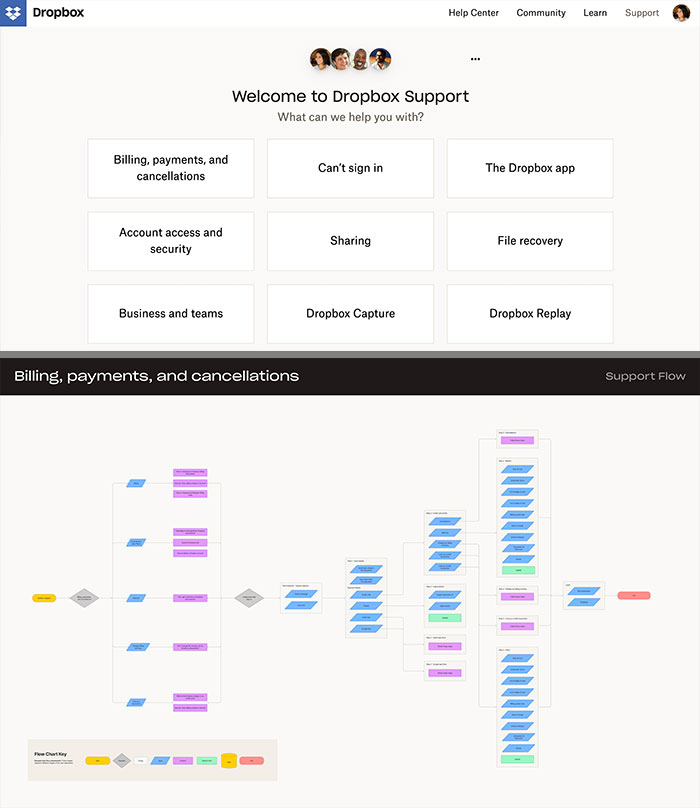
The team agreed on the MVP: a card-based UX where users narrow down their issue by category, then subcategory, then are shown a relevant help article. Scrappy proof of concept to convince leadership and earn more investment. Constraints:
- To trim scope, we didn’t require login. The MVP showed only to logged-in customers on the Basic (free) plan.
- No content recommendation engine. I worked with the help center content team to manually select top-performing articles for Basic SKU and create the IA. The dev team hard-coded the article listings.
- Success metric: clicks on the help article, signaling customers found value in the cards.
07 / MVP success, Phase 2
The MVP was a modest but pivotal success. Customers were clicking articles. At the same time, Dropbox renewed investment in the CX org, including our team and project.
As design lead and content strategist, I helped chart the support roadmap with increasing focus on the recommendation engine:
- Phase 2, determine the most salient analytics and heuristics for weighting articles
- Phase 3, surface relevant articles dynamically; use ML to improve the model
- Phase 4+, personalized, AI-driven support platform
Each phase carries enormous technical and organizational complexity, far beyond any one team or decision-maker. I got a start on Phase 2.
08 / Phase 2: with ChatGPT as collaborator
To conceptualize the Phase 2 architecture, I leaned on ChatGPT with a detailed prompt (summarized):
Act like a content strategist with a high degree of technical architecture and content analytics knowledge, plus extensive editorial experience. You work at Dropbox on the CX team re-engineering the support experience. You’ve been tasked with creating a help center article recommendation engine. The experience starts with customers selecting a category for their issue, then narrowing by subcategory.
The job has two parts: (1) Determine the optimal configuration of analytics so the system recommends the most accurate, relevant article, based on the heuristics below. (2) Generate more queries to measure improvements of the first set.
Each article offers these metrics: helpfulness score, CSAT, page views, traffic, SKU, top trafficked by organic, help center views per session, surface-jumps per session, group by previous URL and referrer fields, group by issue category.
Goals: reduce inbound tickets by surfacing self-serve articles. “Best article” = most relevant + most accurate. SKU-aware: don’t show articles that don’t apply to the customer’s plan.
We want to build a data model that can eventually fit into an AI model that dynamically populates articles based on each customer’s support profile.
09 / Conclusion
My time at Dropbox ended as Phase 2 entered later-stage design and dev handoff. I left with deep expertise in an entire product ecosystem, experience leading a design team, and a working playbook for navigating senior leadership and cross-functional collaboration at scale.
The most interesting part: building an aspirational, world-class structured framework for support content dependent on a multitude of complex inputs and system constraints.
I also spent significant time advocating for design principles across the CX org by cultivating allies with product and content designers across the company. Worth naming because not all orgs see design equally, any designer worth their salt should be ready to articulate the business value of design at every level.