Case study: Creating a content OS inside an AI-native data company
Enrich Layer is a technical B2B data company that sells structured public-web data and enrichment APIs to developers, data teams, and GTM operators.
The challenge
The challenge is content marketing at scale in a category where a single loose claim can cost trust or create a compliance problem. Enrich Layer needs high-volume, precise, compliant content to earn visibility in search and answer engines, and to match larger competitors.
Those goals push against each other: volume usually costs precision, precision slows cadence, and in a data-broker category every piece of content carries compliance risk. A lean team has to deliver all of it at once.
Several forces make that hard:
- Precision is the product. Engineers and data teams punish vague or inaccurate claims, so definitions, coverage, and capability language have to be exact on every page.
- Answer engines reward the clearest source. AEO matters as much as SEO: whoever owns the canonical definition of a term gets surfaced, and competitors are already publishing more of it.
- Every piece carries some compliance risk. Sourcing language, coverage and accuracy claims, competitor comparisons, and data-broker compliance positioning can each become a liability.
- Product truth is distributed. The authoritative product, coverage, and compliance language lives across Slack, Linear, documentation, skills, and the repo, with no single place from which a writer or an AI agent can reliably source.
- The team is lean. Output has to be repeatable at a real cadence, produced by a small team.
Enrich Layer is a developer-first company. The product is an API, and everything around it is headless, including the content. The content is run like code: it’s pulled from the tools the team works in, and ships through git.
The work
Hitting volume, precision, and compliance at the same time is a systems problem. The answer is a layer that pulls the company’s scattered truth into one working context that feeds every brief, draft, and review, so content ships at cadence.
Most of the leverage is created before anything publishes:
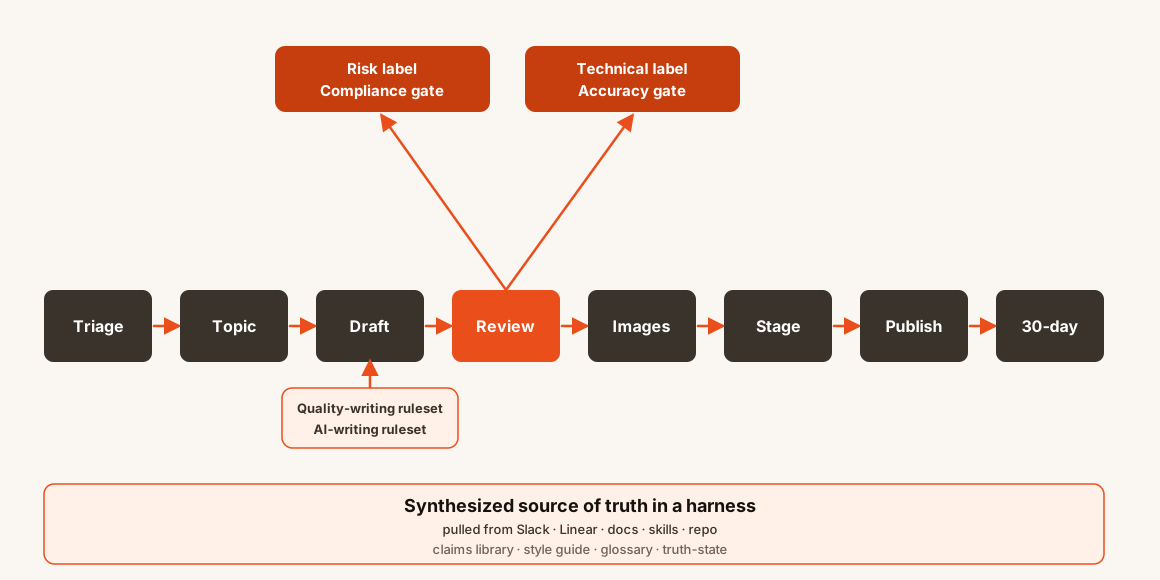
- A synthesized source of truth. A context layer the whole pipeline draws on, assembled by pulling from the company’s tools and repo: agent context briefs and system prompts, an Enrich Layer writing-style guide, a terminology glossary, and a canonical stable-claims library of publish-safe product language. Every brief and draft is checked against it.
- An operationalized SEO/AEO research base. Roughly 1,900 researched keywords (1,482 B2B-data and 463 talent-sourcing) and a 2,500-row content-gap analysis benchmarking enrichlayer.com against named competitors feed a 9,000-word strategy and a set of competitor audits. These cascade into a nine-category taxonomy and a topic-parity bank, including an explicit “avoid” list, mapped to tracked issues and subject-matter owners.
- Reusable AI skills. A library of Claude skills runs the pipeline: one mines internal systems into cited briefs; one enforces sequential editorial gates and a Stable / Provisional / Disputed /
Unknowntruth-state system whereUnknownclaims never ship; one runs an eight-rule compliance pass; others move posts into staging as MDX behind a per-post feature flag. Each skill turns a judgment that used to live in someone’s head into a repeatable step. - An eight-stage pipeline with named gates. Content lives in the repository and moves through an eight-stage pipeline where the stage is the issue status, routed to named human owners for editorial, compliance, technical accuracy, and images by two independent signals: a risk label and a technical label. The compliance rules are concrete: no scraping language, no competitor price or quality comparisons, no absolutist accuracy guarantees, and compliance content held until data-broker registration is confirmed, each with a logged human-override audit trail.
- A review model that clears the bottleneck. A claims-gap report flags any post that touches an unresolved claim and holds it until a human resolves it, so the slow part of review, the final accuracy and compliance read, is scoped to exactly what needs a human instead of every line.
Results
The deliverable is content production infrastructure that produces technically accurate, compliant content at speed.
The system carries the load.
- Keyword and competitor research is operationalized into a populated topic bank and a tracked queue: 21 drafts currently in backlog mapped to Linear issues, with two dozen source drafts staged behind feature flags.
- A repeatable workflow connects research, drafting, quality review, compliance and SEO/AEO review, image brief, and ship, with roughly 15 catalogued skills doing the mechanical work.
- Quality, compliance, and technical accuracy run as enforced checkpoints: a truth-state system where
Unknownnever publishes, an eight-rule compliance pass with a logged override trail, and a technical-label route to a named reviewer. - Posts are being pushed live in the production content package, each behind a feature flag, with a 401-post legacy archive migrating through the same pipeline.
- AI-assisted research and drafting create real production leverage while taste, compliance sign-off, and factual accuracy stay human.
What this buys Enrich Layer is a content marketing engine that runs at the speed of a data company.
New topics enter as triaged issues, move through the same gates, and ship as posts that read as accurate to an engineer and stay safe for a data business, with senior review scoped to the claims that actually need a human. Each post also leaves behind reusable research, claims, and rules that make the next one faster to produce.
In a category where precision is the product and answer engines reward the clearest source, the advantage goes to whoever can publish precise, compliant content fastest.
I built the system for Enrich Layer to be that company.