Case study: Building AI-powered content operations for Recraft
Recraft is a frontier AI lab building generative text-to-image models that rank at the top of Hugging Face’s text-to-image leaderboard, behind only OpenAI and Google. Its creator platform, Recraft Studio, lets designers, marketers, and creative teams generate and edit images, vectors, and mockups using Recraft’s own models alongside other top frontier models.
Recraft needed a repeatable way to turn complex AI product knowledge into clear, publishable content across every customer-facing surface.
The challenge
Recraft shipped new models and Studio features fast enough that landing pages, the supported-models pages, and docs had to be rewritten continuously to keep pace.
Model and Studio capabilities had to be explained to individual creators and teams evaluating Recraft for professional design work. Customer interviews ran on a regular cadence, roughly 3–4 a week, producing a repository of interview data that fed the ICP definitions, messaging, and product-feedback guidance.
Several connected problems made that hard:
- Much of the product story lived in the founder’s head, and the rest was spread across product, design, engineering, marketing, support, and leadership. Keeping messaging consistent as the product changed meant building a single-source content graph that an AI content agent could rely on to produce high-fidelity content.
- SEO/AEO pages had to match each ICP, from individual creators to enterprise and professional graphic-design teams. Beyond evergreen SEO, the work required dozens of targeted, ad-hoc landing pages to test the value proposition against specific target markets, grow the supported-models pages, and support new launches
- Documentation had to orient users who had never touched generative AI, with concepts like prompting, style controls, and editing. No documentation existed at the start. Synthesizing it required walking through every aspect of the product and interviewing subject-matter experts. The result became the source of truth that all marketing materials drew from.
An operating layer was the missing piece. With it in place, the supported-models pages, ICP messaging, and docs could build on one another, so each new landing page, doc, and post started from existing structure instead of from scratch.
The work
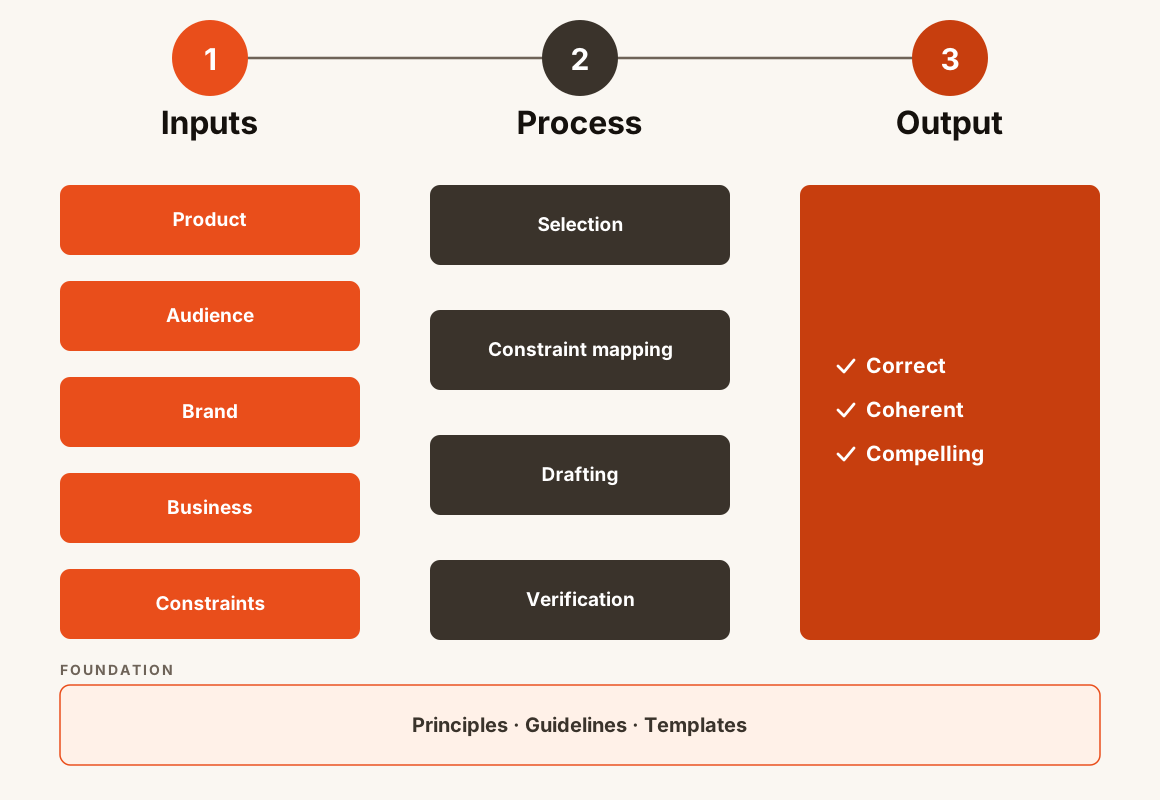
The focus was the content operating layer behind Recraft’s output:
AI being used inside structured frameworks to synthesize source material, generate outlines, test variations, accelerate drafts, and tighten review cycles, with human strategy and editorial judgment setting the message, structure, accuracy, and final bar.
This created leverage from a single senior role: one strategist covering more surfaces, moving faster across messy inputs, turning recurring needs into reusable systems.
- SEO/AEO landing-page systems. Page structures, headings, FAQs, and content patterns built for search visibility, answerability, and readability.
- Product documentation. Feature behavior and product workflows turned into clear docs, tutorials, and explainers covering prompting, style controls, and image editing inside Studio.
- Blog and editorial workflows. Systems for turning product themes, customer use cases, and market conversations into editorial assets.
- Messaging architecture. Reusable frameworks for explaining Recraft’s product, features, use cases, and differentiators in clear, user-facing language, anchored to the single product-truth repository that held the approved claims, messaging guidelines, and compliance language.
- AI-assisted content operations. Repeatable workflows from messy inputs to publishable output: source gathering, briefs, outlines, drafting, revision, QA, repurposing.
Results
Recraft gained a more scalable way to produce accurate, timely, on-brand content around a fast-moving, competitive AI product.
Scattered product knowledge became clear and compelling customer-facing comms across web, documentation, customer support, and editorial surfaces.
- Image generation, Studio controls, and the supported-models lineup were documented in language that creators and design teams could act on.
- The single product-truth repository gave product, features, and use-case content a consistent set of claims and language to build from.
- AI-assisted workflows raised production leverage while holding the editorial bar.
The larger value was operational. Recraft could move faster because each project built on the last, with the advantage coming from the system around the AI: structured inputs, reusable frameworks, clear editorial standards, and senior judgment. For an AI lab shipping at high velocity, the disciplined content system can ship clear, credible content at equal speeds.